








Skip to content
LOW-CODE APP DEVELOPMENT

Custom Low-Code App Development – Built for the AI Era.

VeilSun designs, builds, and evolves mission-critical applications on Quickbase, Mendix, and full-stack platforms — powered by AI, governed for the enterprise, and shipped in weeks instead of quarters.

Custom low-code solutions for today's top companies.

Anyone Can Ship an App Now. That’s Exactly the Problem.

The barrier to building software has collapsed. Lovable, Cursor, Base44, Windsurf, Claude Code — your team can prompt their way to a working interface in an afternoon. The demos look impressive.

Then the audit fails — the integration breaks, the compliance officer flags six issues, and the 'one-prompt' app turns out to share customer data with a model nobody approved. And the half-built thing now lives in production because too many people have started using it to roll it back.

A half-built app costs more than no app at all. That’s not a hot take — it’s the most expensive lesson the last eighteen months of vibe coding have taught the operations leaders we talk to every week.

We use these tools every day. We’re not anti-prompt and we’re not anti-low-code. What we’re against is the assumption that speed is the same as a system. Power without structure is just chaos moving faster.

work-collab-img-jpg

Complex Problems Don’t Require Complex Solutions.

Custom low-code is the right tool for the kind of mission-critical applications that make operations work — CRMs, planning systems, compliance workflows, integrations, field-to-office data flow. The kind of software where “fast and pretty” isn’t enough. It has to hold up under audits, integrate with the financial system, and survive the moment it has to scale.

Low-code lets us deliver in weeks what would take a full-stack team a quarter. It keeps your applications configurable as the business changes. And on platforms like Quickbase and Mendix, it now gives us native AI capabilities that we can build into the workflow instead of bolting on later.

That’s why we lead with low-code. Not because it’s trendy. Because it’s how we reliably ship the right system, fast, on a foundation that compounds.

Two Ways AI Changes the Apps We Build.

AI has changed low-code development in two distinct ways. We treat them as separate engineering problems — and both are part of every modern engagement.

Upwards graph icon
AI as a Delivery Accelerator
Mendix Maia recommends logic and components as we build. Quickbase AI generates app structures and queries. Our own engineering practice uses AI-augmented development to compress timelines without compressing quality. The result: applications that would have taken twelve weeks last year now ship in six.
 
Desktop icon

AI as a Capability Inside Your Application
The more interesting shift. Quickbase AI Actions parse incoming emails into structured records. Photo AI converts field images into compliance data. We’ve built bid-processing workflows that read unstructured contractor emails and populate Quickbase — saving Skinder Construction hundreds of hours per month. We’ve connected Mendix apps to LLM-powered matching engines (Neurotek Connect, helping veterans find the right EMDR therapist). The capability is real. The value is provable.


Every build starts with a technology blueprint.

Mission-critical applications demand a plan that holds up. Our proprietary Technology Blueprint is the discovery process where we map your operation before we touch the build — and it’s where Structure Before AI gets applied to your specific environment.
Discover and define Discover and define

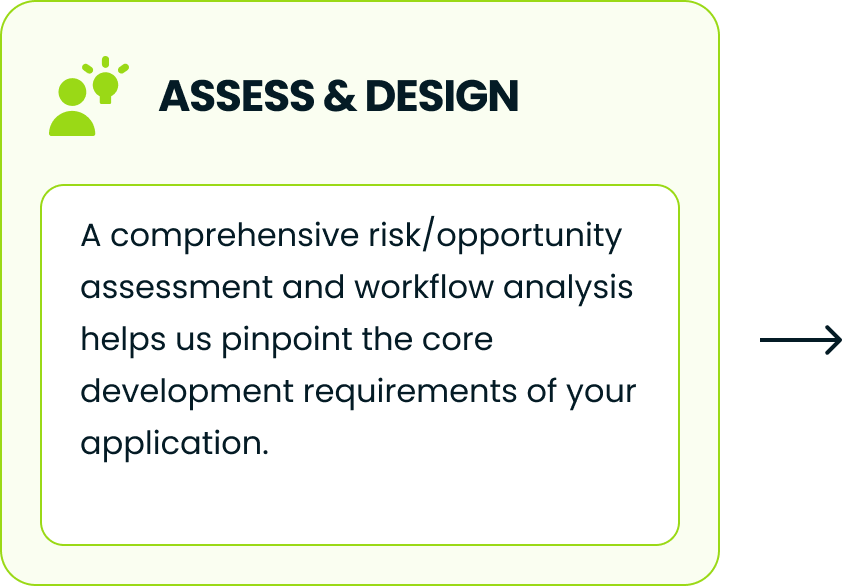
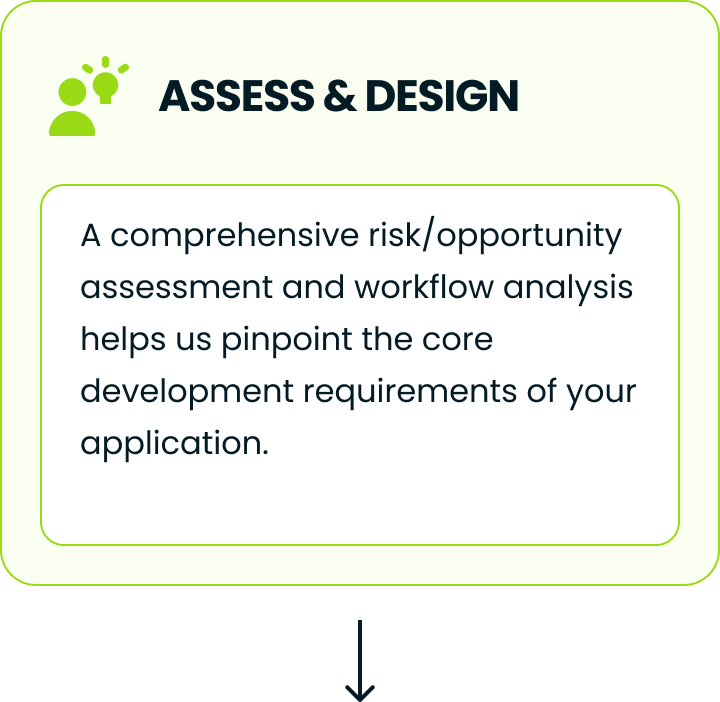
Assess and design Assess and design

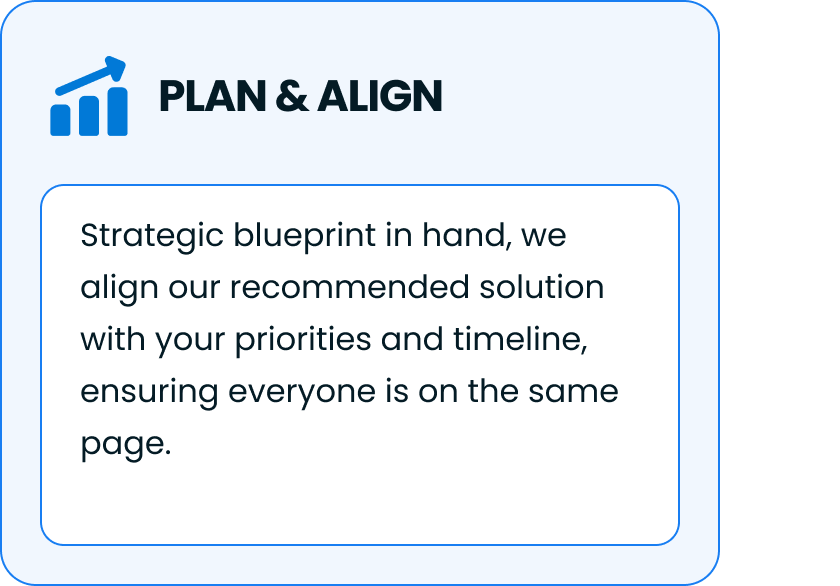
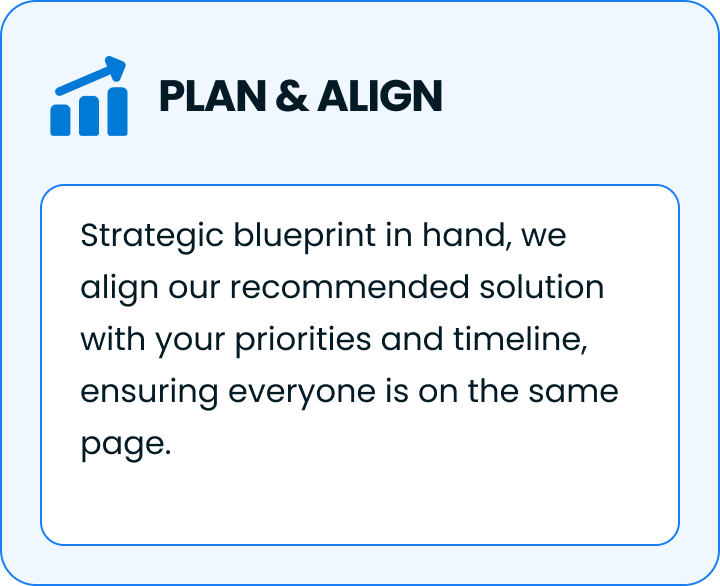
Plan and align Plan and align

We're partners from build to adoption to evolution.

The Technology Blueprint sets the direction. The next three phases are how we deliver — and how we stay accountable for what happens after the launch screen.

Modular icon  Build & Integrate

We build production-grade applications that connect to the systems you already run on — ERPs, CRMs, financial systems, Procore, your data warehouse. Integration depth is where most low-code vendors quietly hand off to an internal team. We don’t.

Interaction icon  Drive Adoption

Software people don’t use is software that didn’t ship. We design for the workflows people live in — and we measure adoption, not deliverables.

Add app icon  Evolve & Adapt

Your software has to keep pace with a business that's changing and platforms that keep shipping. Your application has to change with all of it. That’s why most clients move from a custom build into our Ongoing Development Plan once the initial system goes live.

Get Started.

Sometimes the fastest build is the one that’s already built.

For specific high-volume use cases, VeilSun has packaged years of low-code development into deployable products on Quickbase. When the fit is right, you skip the discovery and head straight to configuration.

If one of these fits your use case, we’ll tell you. If it doesn’t, we’ll build the right thing from scratch.

QScheduler_icon

QSCHEDULER

Native Quickbase scheduling for resource-intensive operations.

QLean-orange-120x120

QLEAN / DIGITAL PULL PLANNING

Lean construction planning, made digital.

custom-workflow-icon

QSAFETY

Safety and compliance workflows for construction operations.

ConstructBase_icon

ConstructBase

Safety and compliance workflows for construction operations.

Our
Focus
Union (1)
TOUCH
Calendar icon PLANNING
& SCHEDULING
PLANNING
& SCHEDULING

Custom planning and scheduling applications for operations leaders who need real-time visibility, dependency tracking, and schedules that reflect what’s happening.

TOUCH
Roadmap icon WORK
COLLABORATION
WORK
COLLABORATION

Connected workflows that eliminate silos, surface the right data at the right moment, and coordinate work across departments.

TOUCH
Resource icon RESOURCE
MANAGEMENT
RESOURCE
MANAGEMENT

Insight into capacity, utilization, risk, and forward-looking planning for the people, equipment, and assets your operation runs on.

TOUCH
Checklist icon COMPLIANCE
& SAFETY
COMPLIANCE
& SAFETY

Automated regulatory workflows and audit trails that flag issues early — instead of after an incident or audit failure.

Start building with low-code.

Low-code case studies

  • CONSTRUCTION
  • HEALTHCARE
  • SOLAR

Construction
Katchmark Construction

Katchmark consolidated multiple disjointed systems into a unified Quickbase CRM. We engineered an application that enhanced project management and sales processes — yielding annual savings, real-time updates, and team collaboration on a single platform.


See case study

Katchmark building

Healthcare
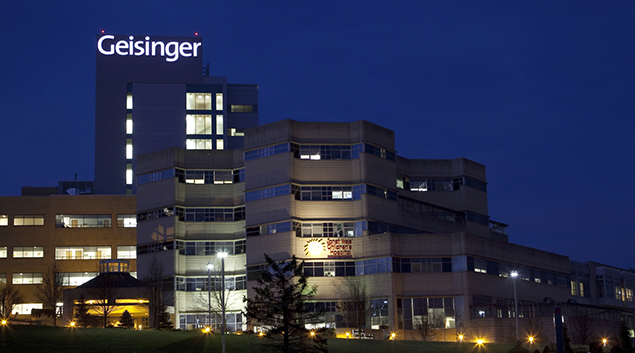
Geisinger Health Plan

Geisinger replaced two $100,000 compliance systems with a single custom Quickbase application — saving over $200,000 annually. The low-code build improved response times, enhanced cross-team collaboration, and consolidated workflows into one source of truth.
See case study

Geisinger building


Solar / Energy
RDS

RDS managed 300% business growth without breaking their operations. We built the system that supported their innovative customer experience model and scaled with them through the growth curve.


See case study

Solar panels

Chat-Bubble-Typing-Oval--Streamline-Core (1)

I was continuously impressed by the Quickbase expertise, problem-solving skills and dedication that they brought to the table. They quickly became a part of our team, understanding our vision and working hand in hand with us to find creative solutions to challenges that came up along the way.

Gina Volk, Nextel Brazil

Why low code?

Complex Problems Don’t Require Complex Solutions.

Software should solve, not cause, your most frustrating problems.  With our low-code approach, we help you innovate faster, reduce development costs, and enhance your operations - without the complexity

Our Rapid App Development team handles the development so you can focus on your business goals.

prototyping-img

FAQ

What is low-code app development and how does VeilSun approach it?

Low-code app development uses visual interfaces and pre-built components to build software faster than traditional code. VeilSun combines low-code platforms (Quickbase, Mendix) with full-stack engineering and AI-accelerated development to deliver mission-critical applications in weeks instead of quarters — with the integrations, governance, and adoption support most low-code shops skip.

Why use VeilSun instead of a vibe-coding tool like Lovable, Cursor, or Base44?

Vibe-coding tools are useful for prototypes and personal projects. They struggle when an application has to integrate with enterprise systems, handle compliance requirements, scale beyond a handful of users, or carry sensitive data. VeilSun builds the production-grade systems those tools can’t — and we use AI in our delivery process to keep the speed advantage.

How does VeilSun use AI in low-code app development?

Two ways. First, as a delivery accelerator — Mendix Maia, Quickbase AI tooling, and our AI-augmented engineering practice compress build timelines without compressing quality. Second, as a capability built into the applications themselves: document parsing, photo AI, intelligent matching, and agent-based workflows applied where they create measurable operational value.

What is the “Structure Before AI” methodology?

It’s our proprietary framework for AI-ready application development. Before any AI capability gets built into an application, we make sure the underlying data, workflows, and integrations can support it. AI accelerates good structure. It buries bad structure. Structure first.

Can low-code platforms support enterprise applications?

Yes. Quickbase and Mendix both support complex business processes, integrate with existing systems, meet enterprise security and compliance standards, and scale to thousands of users. VeilSun’s 17+ years of work includes deployments at Google, Toyota, PayPal, Skanska, Geisinger, and Fifth Third Bank.

How is low-code different from no-code?

Low-code allows for code-level customization when business requirements demand it. No-code is fully visual, designed for users without technical training. We use low-code because mission-critical applications almost always need at least some custom logic, integrations, or extensions that pure no-code can’t provide.

Are low-code applications secure? Modern low-code platforms include enterprise-grade security — role-based access control, encryption at rest and in transit, SOC 2 compliance, and audit logging. We extend that with engineering-level security practices, including the AI guardrails that have become essential as more applications integrate generative AI capabilities.
How long does a typical low-code app development project take? Most engagements run from initial Technology Blueprint to first production release in six to twelve weeks. The Blueprint itself takes two to three weeks. Productized solutions like QScheduler can compress this further. Complex enterprise builds with deep integrations may run longer — but rarely beyond a quarter for the first usable release.
Can VeilSun integrate custom low-code apps with our existing systems? Yes — integration depth is one of our core differentiators. We connect low-code applications to ERPs, CRMs, financial systems, data warehouses, Procore, and field tools. Most of our engagements include integration work as a primary scope item, not an afterthought.
How do I know if low-code is the right fit for my project? Start with an App Checkup or a Discovery Call. If your application needs to integrate with existing systems, support multiple user roles, handle business-specific workflows, and evolve with the business — low-code is almost always the right starting point.

Have additional questions? Book a discovery call to discuss more.

Get in Touch