
Key Takeaways
- "Connective layer" means Quickbase sits across your existing systems and unifies them — it's not one more app in the pile.
- The problem it solves is gray work: the spreadsheets, status emails, and manual re-keying that live between your systems. 45% of professionals lose 11+ hours a week to it, and it costs an estimated $900 billion a year.
- Quickbase connects through Pipelines, APIs, and data mirroring — 40+ pre-built channels, including Procore — into one source of truth.
- Connecting systems and orchestrating a workflow people adopt are two different jobs. The platform does the first. The last mile is where the value is, and it's the part no tool ships for you.
- Structure before AI: connect and clean the data first, then put Operational AI on top of something it can trust.
Every vendor claims to "connect your systems." Most mean they'll add one more login to the stack you already can't keep straight.
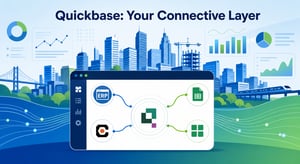
Quickbase as a connective layer is a different claim. It means one system that sits across the tools you already run — your ERP, your Procore instance, your spreadsheets, your point solutions — and pulls them into a single working picture. Not another silo. The thing that ends the silos.
Here's what that actually takes, and where it goes wrong.
What does "connective layer" actually mean?
A connective layer is the system your other systems talk through. Your ERP still owns the financials. Procore still runs the project. But instead of your team hopping between them and stitching the gaps by hand, Quickbase unifies the data into one place people work from.
The distinction matters because most software adds surface area. Every new tool is another place data lives, another export, another thing to reconcile. A connective layer does the opposite — it collapses the hopping into a single, governed source of truth.
That's the whole game for an operations leader running a fragmented stack: not more tools, one place the tools come together.
Why do so many operations run on gray work?
Because the software never covered the space between the systems — so people did, by hand.
Quickbase has a name for it: gray work. The maze of activity that happens outside your core systems but keeps the operation running anyway — the spreadsheet that reconciles two reports, the status email chain, the manual re-keying from one platform into the next.
It is not a rounding error. The numbers:
- 45% of professionals waste more than 11 hours every week chasing information across disconnected platforms.
- Gray work costs an estimated $900 billion a year in lost productivity.
- 90% of workers don't trust the accuracy of their own critical project information.
Read that last one twice. When data is scattered across ERPs, CRMs, spreadsheets, and point solutions, people stop believing any of it — and start keeping their own private copy. That's how a company ends up with five versions of the truth and no way to run on any of them.
The cost of gray work
45%
of professionals lose 11+ hours a week to gray work
$900B
lost to gray work every year
90%
of workers don't trust their own project data
Source: Quickbase gray work research
What makes Quickbase a connective layer and not just another tool?
Three mechanics do the connecting:
- Pipelines — a drag-and-drop builder that moves data and triggers actions across your apps and third-party tools, with 40+ pre-built channels including a Procore channel for construction project data.
- APIs — RESTful connections for the systems that aren't in the pre-built catalog, so nothing is off-limits.
- Data mirroring — keeping datasets in sync across apps so the same fact reads the same everywhere.
On top of that, Quickbase adds a unified source of truth, real-time insight, and governance — so the connection isn't just plumbing, it's controlled. The pitch in their words: integrate everything, control it all, in one dynamic work management platform.
The proof it holds: we rebuilt Katchmark's operation on a single Quickbase system that replaced a stack of disjointed tools and gave the team real-time visibility for the first time. That's a connective layer doing its job — many systems in, one picture out.
The connective layer, in one picture
One System, Not One More App in the Pile
Connected through Pipelines, APIs, and data mirroring — 40+ pre-built channels.
Not another silo. The thing that ends the silos.
Is connecting the systems the same as fixing the problem?
No. And this is the part that decides whether the investment pays off.
Quickbase can connect your systems. It cannot know that your close process has an exception nobody documented, or that your field crews will abandon any screen that takes more than two taps. Connection is the capability. The workflow your specific teams will actually adopt is a separate build — and it's the one that determines whether anyone uses what you connected.
That's the last mile: the distance between data that technically flows and an operation people trust and run on. No platform ships the last mile, because it's different at every company. It's yours.
It's also the difference between the platform and the partner. Quickbase's Pipelines let you orchestrate data between tools. Orchestrating the right technology, data, and human expertise around your actual operation — that's the work we do, and it's what turns a connected stack into an adopted one. We are the experts, so our clients don't have to be.
Where does AI fit into a connective layer?
On top of it — after the connecting is done, never instead of it.
Quickbase is pushing Operational AI to attack gray work directly, and it's a real capability. But AI on a fragmented stack just automates the chaos faster. It needs a connected, trustworthy source of truth underneath before it can produce an answer worth acting on.
That's the whole reason 95% of enterprise AI pilots fail to deliver ROI, per MIT — the foundation wasn't there.
Structure before AI. Connect the systems, clean the data, build the workflow people adopt — then let AI work on top of something solid. Low code moves the work; human-guided AI makes it intelligent. AI isn't sprinkles on top of a cupcake — it's eggs in the batter, and the batter is your connected data.
Making Quickbase your connective layer
If your operation runs on gray work — the spreadsheets between the systems, the reports stitched by hand, the data nobody fully trusts — the fix isn't another tool. It's a layer that pulls what you already have into one place your teams will actually use.
As a Quickbase Elite Partner with 700+ applications deployed over 17+ years, we build that layer right-sized to your operation — connected, governed, and adopted, not just technically integrated.
Start with an App Checkup — a focused look at where your systems break down and what it takes to connect them into one working picture.
Frequently Asked Questions
What does it mean for Quickbase to be a connective layer?
It means Quickbase sits across your existing systems — ERP, Procore, spreadsheets, point solutions — and unifies their data into one source of truth your teams work from, instead of adding another standalone app to hop between.
How does Quickbase connect to other systems?
Through Pipelines (a drag-and-drop builder with 40+ pre-built channels, including Procore), RESTful APIs for anything not pre-built, and data mirroring to keep datasets in sync across apps. Together they move data and trigger actions across your stack in real time.
What is gray work?
Gray work is the manual activity that happens between your core systems to keep the operation running — reconciling spreadsheets, status emails, re-keying data. Research puts it at 11+ hours a week for 45% of professionals and roughly $900 billion a year in lost productivity.
Does connecting my systems fix adoption on its own?
No. Connection is the capability; the workflow your teams actually adopt is a separate build tuned to how your operation really works. That last mile is where most implementations succeed or fail, and it's the part no platform delivers out of the box.
Do I need AI to get value from Quickbase?
No — and AI needs the connective layer first. A connected, trustworthy source of truth is the precondition for Operational AI to work. Structure the data before you automate it; otherwise AI just speeds up the chaos.